PAPUA The Last Paradise on Earth
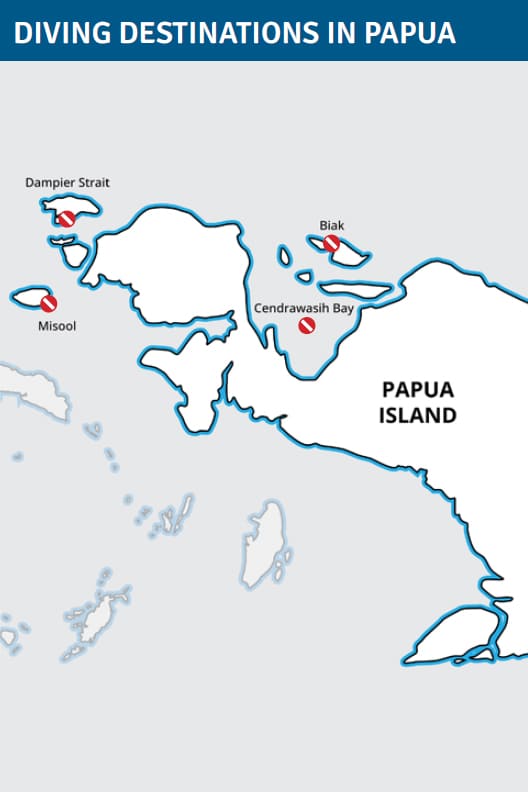 Papua, Indonesia’s easternmost region, boasts a striking natural variety, ranging from tropical beaches and mangroves to alpine peaks and dense rainforests. Formerly known as Irian Jaya, it is now divided into six provinces. The climate is consistently hot and humid, shaped by rugged terrain and a rich biodiversity. Located on the same tectonic plate as Australia, Papua is home to marsupials like tree kangaroos and wallabies, along with many endemic species. It played a key role in Alfred Wallace’s theory of evolution and the concept of the Wallace Line. The region is inhabited by hundreds of indigenous tribes, with traditional ceremonies and festivals such as the Baliem Valley Festival offering insight into its vibrant cultures. Raja Ampat, Cenderawasih Bay, and Biak are globally renowned dive sites, famous for their pristine reefs and encounters with whale sharks. With its cultural richness, untouched nature, and world-class diving, Papua remains a paradise for adventurers seeking raw and unforgettable experiences.
Diving Overview
Raja Ampat ranks among the world’s premier dive destinations, renowned for its untouched reefs, high fish biomass, endemic species, and exceptional encounters with pelagic species. Its varied underwater topography— walls, slopes, canyons, and sheltered lagoons—offers something for all skill levels. Divers are treated to vivid coral gardens, dense schools of reef fish, and frequent sightings of sharks and tunas. The prime season runs from October to June. Its remote location has helped shield it from mass tourism, keeping the reefs intact. Approximately half of the region falls within Marine Protected Areas, which are funded in part by a conservation tag system linked to tourism. Due to limited capacity, early booking is essential for both liveaboards and resorts.
Diving Conditions
Papua’s remote location results in limited phone service and slow, often unreliable internet access. While the region boasts exceptional natural beauty and marine biodiversity, certain areas have been affected by destructive fishing practices. Diving in Papua offers warm water and excellent visibility year-round, particularly in regions like Raja Ampat.
Dive Site and Marine Life Highlights in PAPUA
Papua offers unmatched marine diversity, featuring manta rays, reef and walking sharks, turtles, wobbegongs, pygmy seahorses, nudibranchs, and untouched coral reefs. Signature dive sites such as Blue Magic, Manta Sandy, Sardine Reef, and Cape Kri showcase the region’s biodiversity, while Misool’s iconic sites like Boo and Magic Mountain stand out for their dramatic topography and thriving marine life.
PAPUA The Last Paradise on Earth
Papua, Indonesia’s easternmost region, boasts a striking natural variety, ranging from tropical beaches and mangroves to alpine peaks and dense rainforests. Formerly known as Irian Jaya, it is now divided into six provinces. The climate is consistently hot and humid, shaped by rugged terrain and a rich biodiversity. Located on the same tectonic plate as Australia, Papua is home to marsupials like tree kangaroos and wallabies, along with many endemic species. It played a key role in Alfred Wallace’s theory of evolution and the concept of the Wallace Line. The region is inhabited by hundreds of indigenous tribes, with traditional ceremonies and festivals such as the Baliem Valley Festival offering insight into its vibrant cultures. Raja Ampat, Cenderawasih Bay, and Biak are globally renowned dive sites, famous for their pristine reefs and encounters with whale sharks. With its cultural richness, untouched nature, and world-class diving, Papua remains a paradise for adventurers seeking raw and unforgettable experiences.
Diving Overview
Raja Ampat ranks among the world’s premier dive destinations, renowned for its untouched reefs, high fish biomass, endemic species, and exceptional encounters with pelagic species. Its varied underwater topography— walls, slopes, canyons, and sheltered lagoons—offers something for all skill levels. Divers are treated to vivid coral gardens, dense schools of reef fish, and frequent sightings of sharks and tunas. The prime season runs from October to June. Its remote location has helped shield it from mass tourism, keeping the reefs intact. Approximately half of the region falls within Marine Protected Areas, which are funded in part by a conservation tag system linked to tourism. Due to limited capacity, early booking is essential for both liveaboards and resorts.
Diving Conditions
Papua’s remote location results in limited phone service and slow, often unreliable internet access. While the region boasts exceptional natural beauty and marine biodiversity, certain areas have been affected by destructive fishing practices. Diving in Papua offers warm water and excellent visibility year-round, particularly in regions like Raja Ampat.
Dive Site and Marine Life Highlights in PAPUA
Papua offers unmatched marine diversity, featuring manta rays, reef and walking sharks, turtles, wobbegongs, pygmy seahorses, nudibranchs, and untouched coral reefs. Signature dive sites such as Blue Magic, Manta Sandy, Sardine Reef, and Cape Kri showcase the region’s biodiversity, while Misool’s iconic sites like Boo and Magic Mountain stand out for their dramatic topography and thriving marine life.
THE DAMPIER STRAIT(RAJA AMPAT)
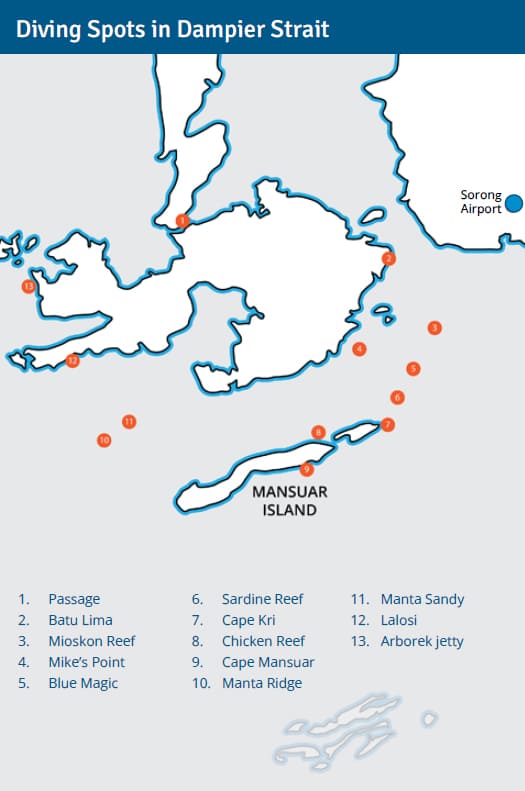 Raja Ampat is the most biodiverse marine region on Earth, home to the highest number of fish, coral, and mollusc species globally. The Dampier Strait showcases an exceptional variety, with distinctive islands, steep rock walls, and sandy bays that are ideal for exploration. Easily accessible from Sorong, it is one of the most popular areas for both liveaboards and landbased resorts.
How To Get There
- Fly to Sorong Domine Eduard Osok Airport (SOQ)
- Continue by taking a ferry or speedboat ride (1 - 2 hours) to Waisai, the capital of Raja Ampat, where most liveaboards and resorts are based.
Diving Conditions
Diving and snorkeling in the Dampier Strait are good year-round, with no distinct dry or rainy season. Currents are constant, bringing abundant marine life but requiring dive planning for all skill levels. Some southern resorts close during windier summer months due to rough conditions.
Visibility : 15 - 30 m
Best Time : Oct - Apr
Slight cooling Jul–Sep to 27–29°C.
Dive Site and Marine Life Highlights in Dampier Strait
Manta rays are a highlight in the Dampier Strait, with sites like Manta Sandy and Blue Magic offering near-guaranteed encounters. Top dive sites include Sardine Reef, Cape Kri—known for a record 374 fish species in a single dive—The Passage, a jungle-like channel with mangroves and an underwater cavern, Mike’s Point with strong currents and dense marine life, and the scenic Fam Islands featuring limestone cliffs and vibrant coral gardens. Snorkelers and freedivers enjoy rich marine life at Manta Sandy’s shallow cleaning station and the striking landscapes of The Passage and Fam Islands.
THE DAMPIER STRAIT(RAJA AMPAT)
Raja Ampat is the most biodiverse marine region on Earth, home to the highest number of fish, coral, and mollusc species globally. The Dampier Strait showcases an exceptional variety, with distinctive islands, steep rock walls, and sandy bays that are ideal for exploration. Easily accessible from Sorong, it is one of the most popular areas for both liveaboards and landbased resorts.
How To Get There
- Fly to Sorong Domine Eduard Osok Airport (SOQ)
- Continue by taking a ferry or speedboat ride (1 - 2 hours) to Waisai, the capital of Raja Ampat, where most liveaboards and resorts are based.
Diving Conditions
Diving and snorkeling in the Dampier Strait are good year-round, with no distinct dry or rainy season. Currents are constant, bringing abundant marine life but requiring dive planning for all skill levels. Some southern resorts close during windier summer months due to rough conditions.
Visibility : 15 - 30 m
Best Time : Oct - Apr
Slight cooling Jul–Sep to 27–29°C.
Dive Site and Marine Life Highlights in Dampier Strait
Manta rays are a highlight in the Dampier Strait, with sites like Manta Sandy and Blue Magic offering near-guaranteed encounters. Top dive sites include Sardine Reef, Cape Kri—known for a record 374 fish species in a single dive—The Passage, a jungle-like channel with mangroves and an underwater cavern, Mike’s Point with strong currents and dense marine life, and the scenic Fam Islands featuring limestone cliffs and vibrant coral gardens. Snorkelers and freedivers enjoy rich marine life at Manta Sandy’s shallow cleaning station and the striking landscapes of The Passage and Fam Islands.
MISOOL (RAJA AMPAT)
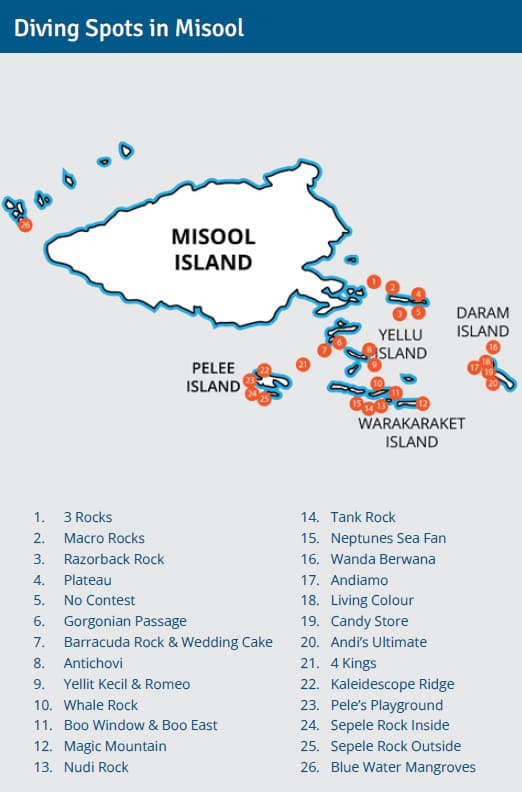 Misool Island, one of the largest and most remote islands in Raja Ampat, is known for its lush forests, limestone pinnacles, white sand beaches, and vibrant marine life. The island is also home to ancient petroglyphs estimated to be 5,000 years old. Misool is primarily accessed by liveaboard boats, with limited landbased options such as Misool Eco Resort. Liveaboard itineraries often combine Misool with the Dampier Strait or the Banda Sea.
How To Get There
- Fly to Sorong Domine Eduard Osok Airport (SOQ)
- Continue by speedboat ride (4 - 5 hours) to Misool or liveaboards
Diving Conditions
Misool offers a diverse range of dive sites, including manta cleaning stations, coral walls, swim-throughs, drift dives, and lagoons, suitable for divers of all levels. Most liveaboards offer nitrox fills; however, nitrox certification or onboard courses are typically required. Due to Misool’s remoteness, the use of nitrox and cautious dive profiles is recommended.
Visibility : 20 - 30 m
Best Time : Oct - Apr
Consistently warm.
Dive Site and Marine Life Highlights in Misool
Misool is home to world-class dive sites, including Boo Windows, Magic Mountain, Fiabacet, and Yillet, all renowned for their vibrant marine life and dramatic topography. Boo Windows is famous for its scenic swim-through and vibrant fish life, featuring unicornfish, octopuses, and green turtles. Fiabacet delivers dense fish populations, clear waters, and regular sightings of hammerheads, barracuda, reef sharks, and bumphead parrotfish. Magic Mountain features a manta ray cleaning station frequented by reef and oceanic mantas, as well as sharks and large pelagic schools. Yillet offers a sloping plateau with caves and ledges that shelter various critters, including barramundi cod, turtles, and schooling barracuda. Snorkeling and freediving in Misool are equally impressive, with pristine reefs and thriving biodiversity accessible to all levels. Highlights include manta rays, sharks, and reef fish across varied underwater terrain—from calm bays to steep walls like Gorgonian Passage—offering unforgettable encounters above and below the surface.
MISOOL (RAJA AMPAT)
Misool Island, one of the largest and most remote islands in Raja Ampat, is known for its lush forests, limestone pinnacles, white sand beaches, and vibrant marine life. The island is also home to ancient petroglyphs estimated to be 5,000 years old. Misool is primarily accessed by liveaboard boats, with limited landbased options such as Misool Eco Resort. Liveaboard itineraries often combine Misool with the Dampier Strait or the Banda Sea.
How To Get There
- Fly to Sorong Domine Eduard Osok Airport (SOQ)
- Continue by speedboat ride (4 - 5 hours) to Misool or liveaboards
Diving Conditions
Misool offers a diverse range of dive sites, including manta cleaning stations, coral walls, swim-throughs, drift dives, and lagoons, suitable for divers of all levels. Most liveaboards offer nitrox fills; however, nitrox certification or onboard courses are typically required. Due to Misool’s remoteness, the use of nitrox and cautious dive profiles is recommended.
Visibility : 20 - 30 m
Best Time : Oct - Apr
Consistently warm.
Dive Site and Marine Life Highlights in Misool
Misool is home to world-class dive sites, including Boo Windows, Magic Mountain, Fiabacet, and Yillet, all renowned for their vibrant marine life and dramatic topography. Boo Windows is famous for its scenic swim-through and vibrant fish life, featuring unicornfish, octopuses, and green turtles. Fiabacet delivers dense fish populations, clear waters, and regular sightings of hammerheads, barracuda, reef sharks, and bumphead parrotfish. Magic Mountain features a manta ray cleaning station frequented by reef and oceanic mantas, as well as sharks and large pelagic schools. Yillet offers a sloping plateau with caves and ledges that shelter various critters, including barramundi cod, turtles, and schooling barracuda. Snorkeling and freediving in Misool are equally impressive, with pristine reefs and thriving biodiversity accessible to all levels. Highlights include manta rays, sharks, and reef fish across varied underwater terrain—from calm bays to steep walls like Gorgonian Passage—offering unforgettable encounters above and below the surface.
CENDERAWASIH BAY
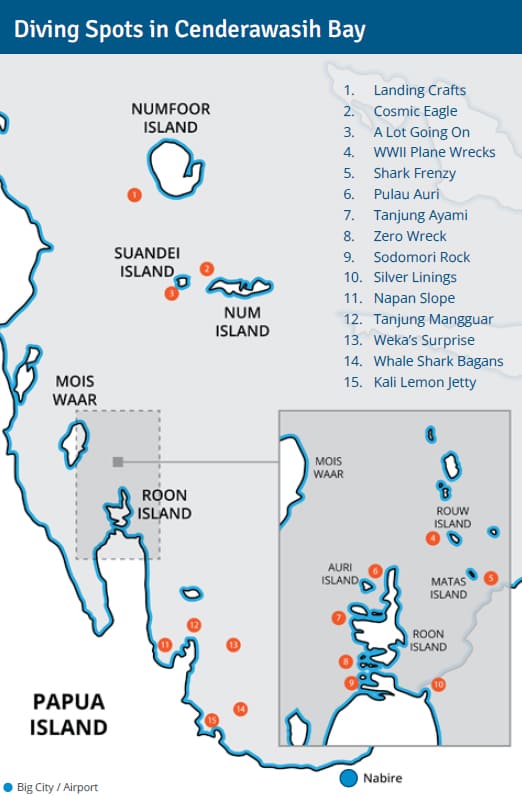 Cenderawasih Bay is remote and accessible only by liveaboard but offers extraordinary rewards—especially for those seeking rare, prolonged encounters with whale sharks. Unlike typical sightings, these gentle giants gather beneath fishing platforms to feed, allowing for extended interaction. Known as “The Galapagos of Indonesia’s reefs,” the bay hosts rich biodiversity, including four turtle species, dolphins, dugongs, and vibrant coral ecosystems. Dive sites range from macro-rich spots to rarely explored World War II wrecks. With its blend of marine megafauna, critters, pristine reefs, and historical relics, Cenderawasih is a must for adventurous divers.
How To Get There
- Fly to Manokwari Rendani Airport (MKW) or Nabire Doue Aturure (NBX), where most liveaboards depart.
Diving Conditions
With visibility ranging from 10 to 30 meters, diving in Cenderawasih Bay caters to divers of all levels, although deeper sites with stronger currents are best suited for advanced divers. Whale shark encounters in shallow Kwatisore Bay are ideal for beginners. Most liveaboards operate from June to October.
Visibility : 10 - 30 m
Best Time : May - Oct
Very warm and stable; often 29–31°C Apr–Nov.
Dive Site and Marine Life Highlights in Cenderawasih Bay
Cenderawasih Bay’s main attraction is the year-round presence of whale sharks in Kwatisore Bay, where divers of all levels can swim among multiple sharks feeding naturally beneath fishing platforms—an unparalleled experience. Near Manokwari, the WWII-era Shinwa Maru wreck offers both recreational and advanced diving opportunities, rich in marine life and featuring preserved artifacts. Sungei Omiand features volcanic black sand and rare macroscopic species, such as pygmy seahorses and blue-ring octopuses. The bay also offers excellent snorkelling and freediving, particularly with whale sharks near the surface, which can be accessed via liveaboard or from shore.
CENDERAWASIH BAY
Cenderawasih Bay is remote and accessible only by liveaboard but offers extraordinary rewards—especially for those seeking rare, prolonged encounters with whale sharks. Unlike typical sightings, these gentle giants gather beneath fishing platforms to feed, allowing for extended interaction. Known as “The Galapagos of Indonesia’s reefs,” the bay hosts rich biodiversity, including four turtle species, dolphins, dugongs, and vibrant coral ecosystems. Dive sites range from macro-rich spots to rarely explored World War II wrecks. With its blend of marine megafauna, critters, pristine reefs, and historical relics, Cenderawasih is a must for adventurous divers.
How To Get There
- Fly to Manokwari Rendani Airport (MKW) or Nabire Doue Aturure (NBX), where most liveaboards depart.
Diving Conditions
With visibility ranging from 10 to 30 meters, diving in Cenderawasih Bay caters to divers of all levels, although deeper sites with stronger currents are best suited for advanced divers. Whale shark encounters in shallow Kwatisore Bay are ideal for beginners. Most liveaboards operate from June to October.
Visibility : 10 - 30 m
Best Time : May - Oct
Very warm and stable; often 29–31°C Apr–Nov.
Dive Site and Marine Life Highlights in Cenderawasih Bay
Cenderawasih Bay’s main attraction is the year-round presence of whale sharks in Kwatisore Bay, where divers of all levels can swim among multiple sharks feeding naturally beneath fishing platforms—an unparalleled experience. Near Manokwari, the WWII-era Shinwa Maru wreck offers both recreational and advanced diving opportunities, rich in marine life and featuring preserved artifacts. Sungei Omiand features volcanic black sand and rare macroscopic species, such as pygmy seahorses and blue-ring octopuses. The bay also offers excellent snorkelling and freediving, particularly with whale sharks near the surface, which can be accessed via liveaboard or from shore.
BIAK
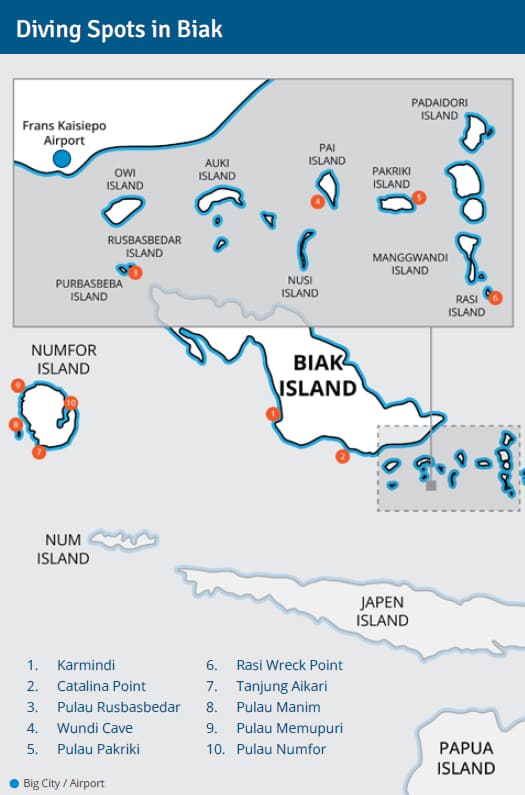 Biak, the largest island in Cenderawasih Bay, is a tropical haven of white sand beaches, palmlined shores, and dense jungle. Covering 2,455 km² and home to around 122,000 people—mostly Melanesians—its central hub is Biak City. First charted by Portuguese explorers in the 1500s, Biak today has limited dive infrastructure, making liveaboards the primary option for divers. Staying on the island provides access to local dive sites, while liveaboards enable exploration of a wider regional area.
How To Get There
- Fly to Biak Frans Kaisepo Airport (BIK)
Diving Conditions
Biak offers year-round diving suitable for all levels. Sheltered bays are ideal for beginners, while deeper, drift, and technical sites cater to advanced divers. Conditions are generally calm. Peak season runs from April to December. Liveaboards typically operate between June and October, adjusting their routes according to monsoon patterns.
Visibility : 15 - 30 m
Best Time : May - Oct
Generally stable with minor mid-year cooling.
Dive Site and Marine Life Highlights in Biak
Biak offers diverse and memorable diving, from the dramatic Wundi Cave and WWII-era wrecks, such as the Catalina bomber, to vibrant coral walls around Rurbas Island, teeming with a wealth of marine life. Encounters may include reef sharks, mantas, rays, turtles, and macro species such as nudibranchs and frogfish. Shallow, colorful reefs just two meters deep make Biak ideal for snorkelers of all levels, including children, with frequent sightings of sea turtles and banded sea kraits. Freedivers can explore walls and drop-offs but should follow safety protocols, especially given Biak’s remote setting.
BIAK
Biak, the largest island in Cenderawasih Bay, is a tropical haven of white sand beaches, palmlined shores, and dense jungle. Covering 2,455 km² and home to around 122,000 people—mostly Melanesians—its central hub is Biak City. First charted by Portuguese explorers in the 1500s, Biak today has limited dive infrastructure, making liveaboards the primary option for divers. Staying on the island provides access to local dive sites, while liveaboards enable exploration of a wider regional area.
How To Get There
- Fly to Biak Frans Kaisepo Airport (BIK)
Diving Conditions
Biak offers year-round diving suitable for all levels. Sheltered bays are ideal for beginners, while deeper, drift, and technical sites cater to advanced divers. Conditions are generally calm. Peak season runs from April to December. Liveaboards typically operate between June and October, adjusting their routes according to monsoon patterns.
Visibility : 15 - 30 m
Best Time : May - Oct
Generally stable with minor mid-year cooling.
Dive Site and Marine Life Highlights in Biak
Biak offers diverse and memorable diving, from the dramatic Wundi Cave and WWII-era wrecks, such as the Catalina bomber, to vibrant coral walls around Rurbas Island, teeming with a wealth of marine life. Encounters may include reef sharks, mantas, rays, turtles, and macro species such as nudibranchs and frogfish. Shallow, colorful reefs just two meters deep make Biak ideal for snorkelers of all levels, including children, with frequent sightings of sea turtles and banded sea kraits. Freedivers can explore walls and drop-offs but should follow safety protocols, especially given Biak’s remote setting.