Introduction to Diving in Indonesia
Dive into the Wonders of Indonesia!
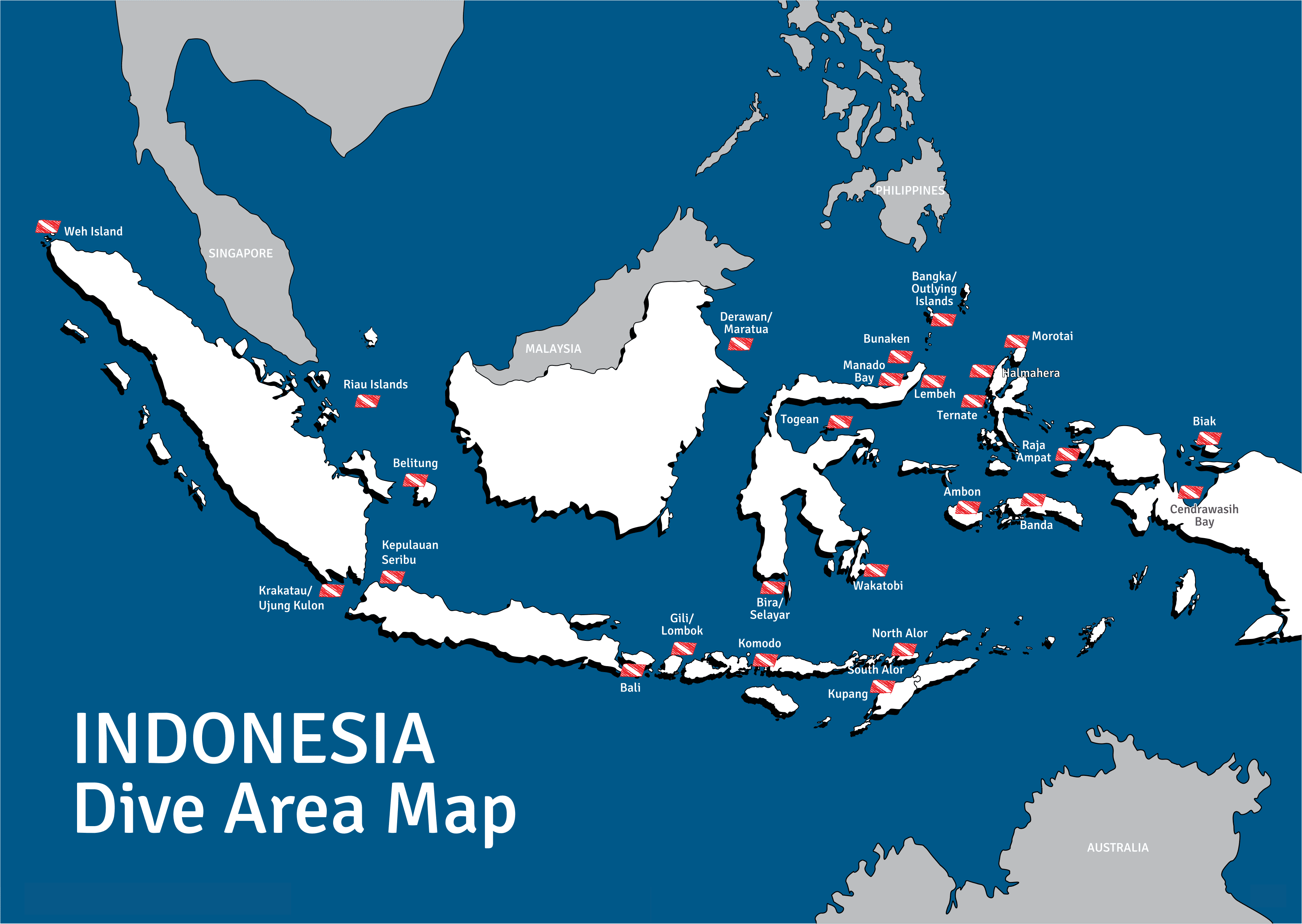
Indonesia, the world’s largest archipelagic nation with over 17,500 islands, lies at the heart of the Coral Triangle—the most biodiverse marine region on the planet. This extraordinary position grants the country a wealth of underwater treasures, offering diving and snorkeling experiences that are both diverse and unmatched globally. From vibrant coral reefs and expansive seagrass beds to encounters with rare marine species and apex predators such as whale sharks, Indonesia presents an exceptional range of dive environments. Each site offers its unique ecological character, ensuring no two experiences are ever the same. Indonesia’s marine ecosystems remain remarkably resilient, showcasing thriving biodiversity despite mounting global environmental pressures. With dive sites suitable for both beginners and experienced divers, the country welcomes all who seek to explore its extraordinary underwater world. Explore the depths of one of the richest marine ecosystems on Earth.
Introduction to Diving in Indonesia
Dive into the Wonders of Indonesia!
Indonesia, the world’s largest archipelagic nation with over 17,500 islands, lies at the heart of the Coral Triangle—the most biodiverse marine region on the planet. This extraordinary position grants the country a wealth of underwater treasures, offering diving and snorkeling experiences that are both diverse and unmatched globally. From vibrant coral reefs and expansive seagrass beds to encounters with rare marine species and apex predators such as whale sharks, Indonesia presents an exceptional range of dive environments. Each site offers its unique ecological character, ensuring no two experiences are ever the same. Indonesia’s marine ecosystems remain remarkably resilient, showcasing thriving biodiversity despite mounting global environmental pressures. With dive sites suitable for both beginners and experienced divers, the country welcomes all who seek to explore its extraordinary underwater world. Explore the depths of one of the richest marine ecosystems on Earth.
Diversity of Diving in the Indonesian Archipelago
Indonesia is renowned for its extraordinary marine biodiversity and wide range of dive experiences, from vibrant reefs and thrilling drifts to caves, deep dives, macro photography sites, and night dives—offering something for every level and interest.
Diversity of Diving in the Indonesian Archipelago
Indonesia is renowned for its extraordinary marine biodiversity and wide range of dive experiences, from vibrant reefs and thrilling drifts to caves, deep dives, macro photography sites, and night dives—offering something for every level and interest.
CORAL REEF DIVING
Coral reefs form the backbone of diving in Indonesia, with reef dives available in nearly every region—though the quality can vary. To protect these fragile ecosystems, divers should maintain excellent buoyancy, observe passively, and refrain from touching the corals or marine life.
TOP 5 Destinations for Coral Reef Diving:
1. Alor, Savu Sea, Eastern Nusa Tenggara
2. Misool, Raja Ampat, Papua
3. Tomia, Wakatobi, Southeast Sulawesi
4. Birds Head Peninsula, Raja Ampat, Papua
5. Komodo National Park, Eastern Nusa Tenggara
CORAL REEF DIVING
Coral reefs form the backbone of diving in Indonesia, with reef dives available in nearly every region—though the quality can vary. To protect these fragile ecosystems, divers should maintain excellent buoyancy, observe passively, and refrain from touching the corals or marine life.
TOP 5 Destinations for Coral Reef Diving:
1. Alor, Savu Sea, Eastern Nusa Tenggara
2. Misool, Raja Ampat, Papua
3. Tomia, Wakatobi, Southeast Sulawesi
4. Birds Head Peninsula, Raja Ampat, Papua
5. Komodo National Park, Eastern Nusa Tenggara
BEGINNER, NOVICE, AND TIMID DIVERS
Every year, thousands of new and novice divers are drawn to Indonesia’s warm, welcoming waters. Ideal beginner dive sites offer depths of 12 - 18 meters, calm and sheltered conditions, clear visibility, and tropical temperatures. Sandy bottoms provide safe areas to practice skills, while minimal boat traffic creates a more relaxed setting. Combined with vibrant marine life, these sites serve as perfect gateways into the underwater world. Instructors aim to build confident, capable divers, and selecting easy, comfortable sites is key to a positive learning experience.
TOP 5 Destinations for Beginners and Novice Divers:
1. Gili Islands, Lombok, Western Nusa Tenggara
2. Tulamben, Bali
3. Bunaken National Park, Northtern Sulawesi
4. Dampier Strait, Raja Ampat, Papua
5. Togean Islands, Central Sulawesi
BEGINNER, NOVICE, AND TIMID DIVERS
Every year, thousands of new and novice divers are drawn to Indonesia’s warm, welcoming waters. Ideal beginner dive sites offer depths of 12 - 18 meters, calm and sheltered conditions, clear visibility, and tropical temperatures. Sandy bottoms provide safe areas to practice skills, while minimal boat traffic creates a more relaxed setting. Combined with vibrant marine life, these sites serve as perfect gateways into the underwater world. Instructors aim to build confident, capable divers, and selecting easy, comfortable sites is key to a positive learning experience.
TOP 5 Destinations for Beginners and Novice Divers:
1. Gili Islands, Lombok, Western Nusa Tenggara
2. Tulamben, Bali
3. Bunaken National Park, Northtern Sulawesi
4. Dampier Strait, Raja Ampat, Papua
5. Togean Islands, Central Sulawesi
HOUSE REEF DIVING
A house reef is a dive site located just off the shore of a resort, easily accessible without the need for boat transfers. Perfect for divers of all levels, a quality house reef offers a rich array of marine life and calm, manageable conditions. Following an initial guided orientation, experienced buddy teams can often explore independently, making house reefs a flexible, convenient, and highly rewarding diving option.
TOP 5 of the Most Notable House Reefs:
1. Selayar Dive Resort House Reef, Selayar Island, Southern Sulawesi
2. Wakatobi Resort House Reef, Tomia, Southern Sulawesi
3. Sorido Bay Resort House Reef, Cape Kri, Raja Ampat, Papua
4. Savu South Alor House Reef, Alor, Eastern Nusa Tenggara
5. Misool Eco Resort, Misool, Raja Ampat, Papua
HOUSE REEF DIVING
A house reef is a dive site located just off the shore of a resort, easily accessible without the need for boat transfers. Perfect for divers of all levels, a quality house reef offers a rich array of marine life and calm, manageable conditions. Following an initial guided orientation, experienced buddy teams can often explore independently, making house reefs a flexible, convenient, and highly rewarding diving option.
TOP 5 of the Most Notable House Reefs:
1. Selayar Dive Resort House Reef, Selayar Island, Southern Sulawesi
2. Wakatobi Resort House Reef, Tomia, Southern Sulawesi
3. Sorido Bay Resort House Reef, Cape Kri, Raja Ampat, Papua
4. Savu South Alor House Reef, Alor, Eastern Nusa Tenggara
5. Misool Eco Resort, Misool, Raja Ampat, Papua
DRIFT DIVING
Drift diving is accessible to all certified divers, though beginners should start with gentle currents. For stronger conditions, additional training—such as the Advanced Open Water or Drift Diver Specialty—is highly recommended. Once mastered, drift diving lets you ride the current effortlessly, enjoy longer dives, cover more reef, and reach sites that were once outside your comfort zone. It’s all about learning to go with the flow.
TOP 5 Destinations for Drift Diving:
1. Komodo National Park, Eastern Nusa Tenggara
2. The Passage (Kabui Passage), Raja Ampat, Papua
3. Pulau Seulako, Pulau Weh, Sumatra
4. Sekolah Dasar Nusa Penida, Bali
5. Cathedral, South Alor, Eastern Nusa Tenggara
DRIFT DIVING
Drift diving is accessible to all certified divers, though beginners should start with gentle currents. For stronger conditions, additional training—such as the Advanced Open Water or Drift Diver Specialty—is highly recommended. Once mastered, drift diving lets you ride the current effortlessly, enjoy longer dives, cover more reef, and reach sites that were once outside your comfort zone. It’s all about learning to go with the flow.
TOP 5 Destinations for Drift Diving:
1. Komodo National Park, Eastern Nusa Tenggara
2. The Passage (Kabui Passage), Raja Ampat, Papua
3. Pulau Seulako, Pulau Weh, Sumatra
4. Sekolah Dasar Nusa Penida, Bali
5. Cathedral, South Alor, Eastern Nusa Tenggara
DEEP DIVING
Divers should always respect the depth limits of their certification—18 meters (60 feet) for Open Water and 30 meters (100 feet) for Advanced Open Water. Depths beyond 30 meters are reserved for those with deep or technical diving certifications. Deep diving involves additional risks, including pressure effects and decompression considerations, so proper training is essential. In Indonesia, venturing deeper can improve your chances of encountering rare species like mola-mola, hammerhead sharks, and marble rays—though sightings are never guaranteed.
TOP 5 Destinations for Deep Diving:
1. Selayar Island’s East Coast, Southern Sulawesi
2. Bunaken National Park, Northern Sulawesi
3. Tomia, Wakatobi, Southern Sulawesi
4. Pulau Alor, Savu Sea, Eastern Nusa Tenggara
5. Belongas Bay, Lombok, Western Nusa Tenggara
DEEP DIVING
Divers should always respect the depth limits of their certification—18 meters (60 feet) for Open Water and 30 meters (100 feet) for Advanced Open Water. Depths beyond 30 meters are reserved for those with deep or technical diving certifications. Deep diving involves additional risks, including pressure effects and decompression considerations, so proper training is essential. In Indonesia, venturing deeper can improve your chances of encountering rare species like mola-mola, hammerhead sharks, and marble rays—though sightings are never guaranteed.
TOP 5 Destinations for Deep Diving:
1. Selayar Island’s East Coast, Southern Sulawesi
2. Bunaken National Park, Northern Sulawesi
3. Tomia, Wakatobi, Southern Sulawesi
4. Pulau Alor, Savu Sea, Eastern Nusa Tenggara
5. Belongas Bay, Lombok, Western Nusa Tenggara
NIGHT DIVING
Wreck diving offers a uniquely captivating experience, blending history with underwater adventure. Non-penetration dives are suitable for all certified divers, but additional training significantly enhances both safety and enjoyment. Advanced and specialty courses cover key skills such as wreck navigation, hazard awareness, safe penetration techniques, and emergency procedures.
TOP 5 Wreck Sites for Wreck Divers:
1. Duke of Sparta, Ambon Bay, Maluku
2. Sophie Rickmers, Pulau Weh, Sumatra
3. USAT Liberty Shipwreck, Tulamben, Bali
4. Boga Wreck, Tulamben, Bali
5. Mawali Wreck, Lembeh, Northern Sulawesi
NIGHT DIVING
Wreck diving offers a uniquely captivating experience, blending history with underwater adventure. Non-penetration dives are suitable for all certified divers, but additional training significantly enhances both safety and enjoyment. Advanced and specialty courses cover key skills such as wreck navigation, hazard awareness, safe penetration techniques, and emergency procedures.
TOP 5 Wreck Sites for Wreck Divers:
1. Duke of Sparta, Ambon Bay, Maluku
2. Sophie Rickmers, Pulau Weh, Sumatra
3. USAT Liberty Shipwreck, Tulamben, Bali
4. Boga Wreck, Tulamben, Bali
5. Mawali Wreck, Lembeh, Northern Sulawesi
WRECK DIVING
As the sun dips below the horizon, the underwater world transforms. While some marine creatures settle in for the night, others emerge from their hiding places. Indonesia’s waters come alive after dark with fascinating nocturnal species—think tiny octopuses, hunting moray eels, and even elusive walking sharks. Many of the best night dives take place at muck sites, where the seafloor teems with nocturnal activity and stealthy predators on the prowl.
TOP 5 Destinations for Night Diving:
1. Lembeh Strait, Northern Sulawesi
2. Ambon Bay, Maluku
3. Misool, Raja Ampat, Papua
4. Tomia, Wakatobi, Southern Sulawesi
5. USAT Liberty Wreck, Tulamben, Bali
WRECK DIVING
As the sun dips below the horizon, the underwater world transforms. While some marine creatures settle in for the night, others emerge from their hiding places. Indonesia’s waters come alive after dark with fascinating nocturnal species—think tiny octopuses, hunting moray eels, and even elusive walking sharks. Many of the best night dives take place at muck sites, where the seafloor teems with nocturnal activity and stealthy predators on the prowl.
TOP 5 Destinations for Night Diving:
1. Lembeh Strait, Northern Sulawesi
2. Ambon Bay, Maluku
3. Misool, Raja Ampat, Papua
4. Tomia, Wakatobi, Southern Sulawesi
5. USAT Liberty Wreck, Tulamben, Bali
BLACKWATER DIVING
Blackwater diving is a one-of-a-kind night dive conducted over deep, open ocean—far from the reefs. Powerful lights are suspended from a drifting boat to attract plankton, which in turn draws in rare and alien-like juvenile creatures carried by the currents. Divers drift alongside the boat, staying close to the lights to witness this vertical slice of the ocean’s food chain. This specialized diving requires excellent buoyancy control and strong night diving skills. While still relatively new in Indonesia, a growing number of operators now offer this extraordinary experience.
TOP 5 Destinations for Blackwater Diving:
1. Lembeh Strait, Northern Sulawesi
2. Tulamben, Bali
3. Manado Bay, Northern Sulawesi
4. Kri Island, Raja Ampat, Papua
5. Ambon Bay, Maluku
BLACKWATER DIVING
Blackwater diving is a one-of-a-kind night dive conducted over deep, open ocean—far from the reefs. Powerful lights are suspended from a drifting boat to attract plankton, which in turn draws in rare and alien-like juvenile creatures carried by the currents. Divers drift alongside the boat, staying close to the lights to witness this vertical slice of the ocean’s food chain. This specialized diving requires excellent buoyancy control and strong night diving skills. While still relatively new in Indonesia, a growing number of operators now offer this extraordinary experience.
TOP 5 Destinations for Blackwater Diving:
1. Lembeh Strait, Northern Sulawesi
2. Tulamben, Bali
3. Manado Bay, Northern Sulawesi
4. Kri Island, Raja Ampat, Papua
5. Ambon Bay, Maluku
WALL DIVING
Wall diving depends on the site’s topography and is only found in select regions of Indonesia. These dives usually begin on a shallow reef before descending along a dramatic vertical coral wall that plunges into the depths. Good buoyancy control is essential, as there’s often no visible bottom. Divers stay neutrally buoyant, drifting or swimming alongside the wall while observing its rich marine life - always remembering to glance out into the blue for unexpected pelagic encounters.
TOP 5 Destinations for Wall Diving:
1. Bonetapalang, Selayar Island, Southern Sulawesi
2. Tomia, Wakatobi, Southern Sulawesi
3. Bunaken National Park, Northern Sulawesi
4. Alor & Savu Sea, Eastern Nusa Tenggara
5. Menjangan Island, Pemuteran, Bali
WALL DIVING
Wall diving depends on the site’s topography and is only found in select regions of Indonesia. These dives usually begin on a shallow reef before descending along a dramatic vertical coral wall that plunges into the depths. Good buoyancy control is essential, as there’s often no visible bottom. Divers stay neutrally buoyant, drifting or swimming alongside the wall while observing its rich marine life - always remembering to glance out into the blue for unexpected pelagic encounters.
TOP 5 Destinations for Wall Diving:
1. Bonetapalang, Selayar Island, Southern Sulawesi
2. Tomia, Wakatobi, Southern Sulawesi
3. Bunaken National Park, Northern Sulawesi
4. Alor & Savu Sea, Eastern Nusa Tenggara
5. Menjangan Island, Pemuteran, Bali
MUCK DIVING
Muck diving is all about the thrill of discovering rare and unusual critters in sandy, low-coral environments—often over black volcanic sand. These creatures are masters of camouflage, making the search part of the excitement, especially on night dives. Highly popular among macro photographers, muck diving draws divers of all levels to Indonesia’s world-renowned sites, offering a chance to spot some of the ocean’s most elusive and fascinating species.
TOP 5 Destinations for Muck Diving:
1. Lembeh Strait, Northern Sulawesi
2. Ambon Bay, Maluku
3. Tulamben, Bali
4. Biak & Cenderawasih Bay, Papua
5. Manado Bay, Northern Sulawesi
MUCK DIVING
Muck diving is all about the thrill of discovering rare and unusual critters in sandy, low-coral environments—often over black volcanic sand. These creatures are masters of camouflage, making the search part of the excitement, especially on night dives. Highly popular among macro photographers, muck diving draws divers of all levels to Indonesia’s world-renowned sites, offering a chance to spot some of the ocean’s most elusive and fascinating species.
TOP 5 Destinations for Muck Diving:
1. Lembeh Strait, Northern Sulawesi
2. Ambon Bay, Maluku
3. Tulamben, Bali
4. Biak & Cenderawasih Bay, Papua
5. Manado Bay, Northern Sulawesi
SHORE DIVING
While many dive sites in Indonesia offer shore access, only a few stand out for their easy entry and rich marine life. Shore diving isn’t always possible—cliffside coastlines or rough sea conditions, like strong waves, can make entry unsafe. Divers typically wade in fully geared (minus fins), swim out, and then descend; exits follow the same process in reverse. Some of the best shore dives are found on house reefs—vibrant sites located just off resort beaches. These allow guests to dive at their convenience, without relying on boat schedules, making them ideal for flexibility and frequent underwater exploration.
TOP 5 Destinations for Shore Diving:
1. Tomia, Wakatobi, Southern Sulawesi
2. Lembeh Strait, Northern Sulawesi
3. Tulamben, Bali
4. Gili Islands, Western Nusa Tenggara
5. Manado Bay, Northern Sulawesi
SHORE DIVING
While many dive sites in Indonesia offer shore access, only a few stand out for their easy entry and rich marine life. Shore diving isn’t always possible—cliffside coastlines or rough sea conditions, like strong waves, can make entry unsafe. Divers typically wade in fully geared (minus fins), swim out, and then descend; exits follow the same process in reverse. Some of the best shore dives are found on house reefs—vibrant sites located just off resort beaches. These allow guests to dive at their convenience, without relying on boat schedules, making them ideal for flexibility and frequent underwater exploration.
TOP 5 Destinations for Shore Diving:
1. Tomia, Wakatobi, Southern Sulawesi
2. Lembeh Strait, Northern Sulawesi
3. Tulamben, Bali
4. Gili Islands, Western Nusa Tenggara
5. Manado Bay, Northern Sulawesi
CAVE DIVING
Cave diving is an advanced form of scuba that involves exploring underwater spaces with overhead barriers and no direct access to the surface or natural light. It requires specialized training, strict safety protocols, and a disciplined mindset. Due to its risks, cave diving is only suitable for certified professionals who understand their limits and the capabilities of their equipment. Indonesia’s volcanic and geological diversity offers a diverse range of cave types, including sinkholes, springs, gypsum caves, and sea caves. While not all are diveable, a few select sites provide truly exceptional cave diving experiences.
TOP 5 Destinations for Cave Diving:
1. Oehani Cave, Kupang, Eastern Nusa Tenggara
2. Muna island, Buton, Southern Sulawesi
3. Tomia, Wakatobi, Southern Sulawesi
4. Baubau, Buton, Southern Sulawesi
5. Kristal Cave, Kupang, Eastern Nusa Tenggara
CAVE DIVING
Cave diving is an advanced form of scuba that involves exploring underwater spaces with overhead barriers and no direct access to the surface or natural light. It requires specialized training, strict safety protocols, and a disciplined mindset. Due to its risks, cave diving is only suitable for certified professionals who understand their limits and the capabilities of their equipment. Indonesia’s volcanic and geological diversity offers a diverse range of cave types, including sinkholes, springs, gypsum caves, and sea caves. While not all are diveable, a few select sites provide truly exceptional cave diving experiences.
TOP 5 Destinations for Cave Diving:
1. Oehani Cave, Kupang, Eastern Nusa Tenggara
2. Muna island, Buton, Southern Sulawesi
3. Tomia, Wakatobi, Southern Sulawesi
4. Baubau, Buton, Southern Sulawesi
5. Kristal Cave, Kupang, Eastern Nusa Tenggara
TECHNICAL DIVING
Technical diving extends beyond recreational limits—typically deeper than 40 meters—and involves decompression stops and access to more challenging environments, such as caves and wrecks. It requires specialized equipment such as rebreathers, sidemount systems, multiple tanks, and advanced thermal protection for longer, colder dives. Tech divers must undergo rigorous training, with a solid understanding of gas mixtures, decompression procedures, and risk management. This level of diving is only for those with the proper certifications and experience. Indonesia is a rising tech diving haven, offering deep-sea biodiversity and challenging sites. A region’s success as a technical diving destination depends on two key factors: suitable dive conditions (depth, topography, accessibility) and proper support infrastructure (gear, gases, boats, trained crew, and instructors). Where both exist, tech diving thrives—where they don't, potential remains untapped.
TOP 5 Destinations for Technical Diving:
1. Gili Trawangan, Western Nusa Tenggara
2. Bunaken National Park, Northern Sulawesi
3. Nusa Penida, Bali
4. Amed, Tulamben & Padangbai, Bali
5. Komodo National Park, Eastern Nusa Tenggara
TECHNICAL DIVING
Technical diving extends beyond recreational limits—typically deeper than 40 meters—and involves decompression stops and access to more challenging environments, such as caves and wrecks. It requires specialized equipment such as rebreathers, sidemount systems, multiple tanks, and advanced thermal protection for longer, colder dives. Tech divers must undergo rigorous training, with a solid understanding of gas mixtures, decompression procedures, and risk management. This level of diving is only for those with the proper certifications and experience. Indonesia is a rising tech diving haven, offering deep-sea biodiversity and challenging sites. A region’s success as a technical diving destination depends on two key factors: suitable dive conditions (depth, topography, accessibility) and proper support infrastructure (gear, gases, boats, trained crew, and instructors). Where both exist, tech diving thrives—where they don't, potential remains untapped.
TOP 5 Destinations for Technical Diving:
1. Gili Trawangan, Western Nusa Tenggara
2. Bunaken National Park, Northern Sulawesi
3. Nusa Penida, Bali
4. Amed, Tulamben & Padangbai, Bali
5. Komodo National Park, Eastern Nusa Tenggara
LIVEABOARD DIVING
Liveaboards are the heart of Indonesia's dive tourism, offering access to remote, world-class sites like Raja Ampat, Komodo, and the Banda Sea—places often out of reach for day boats.
TOP 5 Destinations for Liveaboard Diving:
1. Banda Sea (Forgotten Islands/ Spice Islands), Maluku
2. Raja Ampat (Misool/Dampier Strait), Papua
3. Komodo National Park, Eastern Nusa Tenggara
4. Alor Archipelago & Savu Sea, Eastern Nusa Tenggara
5. Biak & Cenderawasih Bay, Papua
LIVEABOARD DIVING
Liveaboards are the heart of Indonesia's dive tourism, offering access to remote, world-class sites like Raja Ampat, Komodo, and the Banda Sea—places often out of reach for day boats.
TOP 5 Destinations for Liveaboard Diving:
1. Banda Sea (Forgotten Islands/ Spice Islands), Maluku
2. Raja Ampat (Misool/Dampier Strait), Papua
3. Komodo National Park, Eastern Nusa Tenggara
4. Alor Archipelago & Savu Sea, Eastern Nusa Tenggara
5. Biak & Cenderawasih Bay, Papua
Indonesia’s Living Reefs Located in the Heart of the Coral Triangle
Indonesia’s Coral Reefs
Indonesia offers a stunning variety of coral reefs, including fringing reefs, barrier reefs, and atolls. Dive sites range from shallow lagoons with calm waters to deep-sea pinnacles with strong currents. Indonesian reefs are home to over 500 coral species, 10,000 invertebrates and sea plants, and more than 3,000 fish species. They host 6 of the world’s seven turtle species and are vital migration routes for over 30 marine mammal species, including a third of all whale and dolphin species. In short, Indonesia's reefs support the planet’s most diverse and abundant marine life.
Indonesia’s Living Reefs Located in the Heart of the Coral Triangle
Indonesia’s Coral Reefs
Indonesia offers a stunning variety of coral reefs, including fringing reefs, barrier reefs, and atolls. Dive sites range from shallow lagoons with calm waters to deep-sea pinnacles with strong currents. Indonesian reefs are home to over 500 coral species, 10,000 invertebrates and sea plants, and more than 3,000 fish species. They host 6 of the world’s seven turtle species and are vital migration routes for over 30 marine mammal species, including a third of all whale and dolphin species. In short, Indonesia's reefs support the planet’s most diverse and abundant marine life.
Fringing Reefs
Fringing reefs in Indonesia are shallow coral reefs that grow along the edges of islands or landmasses. These reefs typically feature a flat area at depths of 1 - 10 meters, dropping into sloping or vertical walls. While they host mainly robust branching corals, wave action often causes coral damage and rubble, which is a natural occurrence. Fringing reefs are rich in marine life, attracting pelagic species such as sharks, rays, and molas due to the nutrient-rich currents that flow through them. They are widely distributed across Indonesia and can be accessed by boat or shore.
Fringing Reefs
Fringing reefs in Indonesia are shallow coral reefs that grow along the edges of islands or landmasses. These reefs typically feature a flat area at depths of 1 - 10 meters, dropping into sloping or vertical walls. While they host mainly robust branching corals, wave action often causes coral damage and rubble, which is a natural occurrence. Fringing reefs are rich in marine life, attracting pelagic species such as sharks, rays, and molas due to the nutrient-rich currents that flow through them. They are widely distributed across Indonesia and can be accessed by boat or shore.
Barrier Reefs
A barrier reef is a fringing reef where the back reef forms a large lagoon. The Great Barrier Reef in Australia is the most famous example, stretching 2,000 kilometers and featuring lagoons that are up to 100 kilometers wide. Barrier reefs often surround islands in a ripple-like formation, with the lagoon harboring smaller patch reefs. Charles Darwin theorized that barrier reefs start as fringing reefs that grow outward, leaving a lagoon, and if the island subsides, an atoll forms.
Barrier Reefs
A barrier reef is a fringing reef where the back reef forms a large lagoon. The Great Barrier Reef in Australia is the most famous example, stretching 2,000 kilometers and featuring lagoons that are up to 100 kilometers wide. Barrier reefs often surround islands in a ripple-like formation, with the lagoon harboring smaller patch reefs. Charles Darwin theorized that barrier reefs start as fringing reefs that grow outward, leaving a lagoon, and if the island subsides, an atoll forms.
Atolls
Atolls are stunning, circular coral formations with central lagoons that rise from deep waters. Indonesia’s largest atoll, Taka Bonerate in Southern Sulawesi, is the third largest in the world, spanning 72 by 36 kilometers and containing over 20 islands. Atoll lagoons are nutrient-rich due to deep ocean water filtering through the coral walls, making them highly concentrated and unaffected by land-based pollutants. This allows atoll lagoons to support a diverse array of marine life. While Darwin's theory suggests that atolls form from fringing reefs growing outward, recent geological evidence supports an alternative theory involving the erosion of limestone islands and rising sea levels, leaving only a coral rim behind.
Atolls
Atolls are stunning, circular coral formations with central lagoons that rise from deep waters. Indonesia’s largest atoll, Taka Bonerate in Southern Sulawesi, is the third largest in the world, spanning 72 by 36 kilometers and containing over 20 islands. Atoll lagoons are nutrient-rich due to deep ocean water filtering through the coral walls, making them highly concentrated and unaffected by land-based pollutants. This allows atoll lagoons to support a diverse array of marine life. While Darwin's theory suggests that atolls form from fringing reefs growing outward, recent geological evidence supports an alternative theory involving the erosion of limestone islands and rising sea levels, leaving only a coral rim behind.
Coral Reef Marine Life Conservation and Marine Protected Areas
Coral reefs worldwide, including those in Indonesia, are under increasing pressure from various threats. Overfishing, destructive
fishing practices such as cyanide and dynamite fishing, and irresponsible tourism are significant concerns. Anchors also contribute to reef damage. While Indonesia boasts many pristine reefs, these global issues affect parts of the archipelago. To support conservation, divers should choose operators with strong sustainability policies. The Indonesian government has made significant strides in coral reef conservation, establishing numerous national parks and marine protected areas (MPAs) across the country. Most MPAs are no-take zones, prohibiting fishing, turtle egg harvesting, anchoring, and shell collecting. Some MPAs have designated zones for different activities. While these efforts are positive, enforcement remains a challenge. Visitors can help by diving, snorkeling, or freediving in MPAs, where fees from entry tags support conservation projects. Always inquire about purchasing a marine park tag when diving in these areas. Indonesia has established 411 Marine Protected Areas (MPAs) across the archipelago as of 2023, covering around 9% of its territorial waters (over 28 million hectares). Notable MPAs include:
• Komodo National Park (Eastern Nusa Tenggara)
• Bunaken National Park (Northern Sulawesi)
• Raja Ampat MPAs, including Fam Islands, Kofiau, Boo Islands,
Misool, Southeast Misool, and Dampier Strait (Papua)
• Nusa Penida MPA (Bali)
• Taka Bonerate National Park (Southern Sulawesi)
• Karimunjawa MPA (Java)
• Togean Island National Park (Central Sulawesi)
• Kepulauan Seribu National Park (Java)
• Wakatobi National Park (Southern Sulawesi)
Alongside these parks, numerous independent conservation projects, such as turtle hatcheries, manta ray identification databases, artificial reefs, and coral monitoring, are underway throughout Indonesia. Many of these initiatives welcome support and offer educational opportunities. Check with dive operators for conservation projects in your visit area.
Coral Reef Marine Life Conservation and Marine Protected Areas
Coral reefs worldwide, including those in Indonesia, are under increasing pressure from various threats. Overfishing, destructive
fishing practices such as cyanide and dynamite fishing, and irresponsible tourism are significant concerns. Anchors also contribute to reef damage. While Indonesia boasts many pristine reefs, these global issues affect parts of the archipelago. To support conservation, divers should choose operators with strong sustainability policies. The Indonesian government has made significant strides in coral reef conservation, establishing numerous national parks and marine protected areas (MPAs) across the country. Most MPAs are no-take zones, prohibiting fishing, turtle egg harvesting, anchoring, and shell collecting. Some MPAs have designated zones for different activities. While these efforts are positive, enforcement remains a challenge. Visitors can help by diving, snorkeling, or freediving in MPAs, where fees from entry tags support conservation projects. Always inquire about purchasing a marine park tag when diving in these areas. Indonesia has established 411 Marine Protected Areas (MPAs) across the archipelago as of 2023, covering around 9% of its territorial waters (over 28 million hectares). Notable MPAs include:
• Komodo National Park (Eastern Nusa Tenggara)
• Bunaken National Park (Northern Sulawesi)
• Raja Ampat MPAs, including Fam Islands, Kofiau, Boo Islands,
Misool, Southeast Misool, and Dampier Strait (Papua)
• Nusa Penida MPA (Bali)
• Taka Bonerate National Park (Southern Sulawesi)
• Karimunjawa MPA (Java)
• Togean Island National Park (Central Sulawesi)
• Kepulauan Seribu National Park (Java)
• Wakatobi National Park (Southern Sulawesi)
Alongside these parks, numerous independent conservation projects, such as turtle hatcheries, manta ray identification databases, artificial reefs, and coral monitoring, are underway throughout Indonesia. Many of these initiatives welcome support and offer educational opportunities. Check with dive operators for conservation projects in your visit area.
SUMATRA The Natural Beauty and Exceptional Wildlife
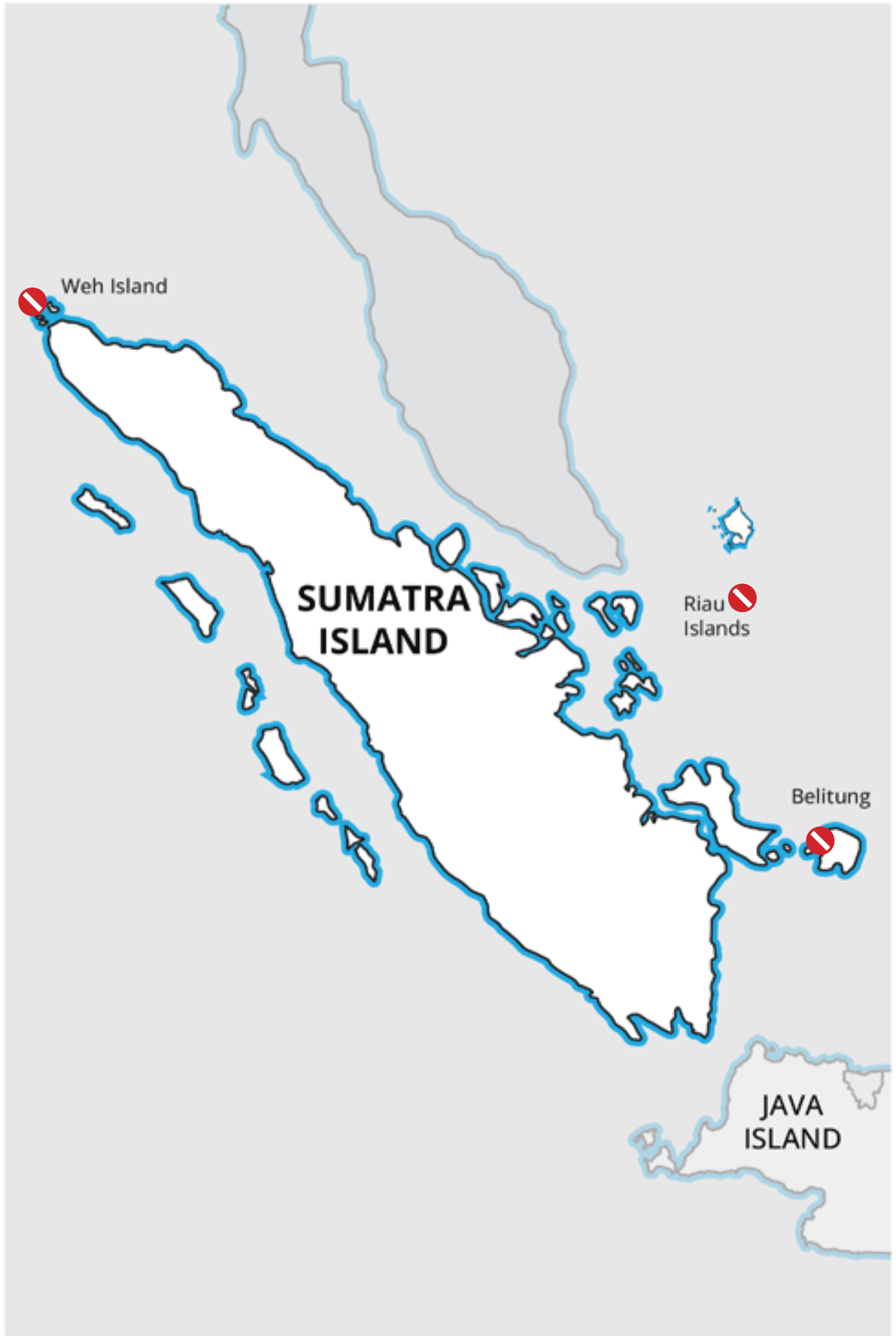 Sumatra, Indonesia’s westernmost and largest island, spans over 473,000 square kilometers and ranks as the sixth-largest island in the world. Known for its dramatic landscapes, the island features active volcanoes, crater lakes, dense jungles, and some of the world’s most pristine beaches. Its natural beauty is matched by rich biodiversity, home to critically endangered species such as orangutans, tigers, rhinos, and elephants. Sumatra is also a top destination for world-class surfing and eco-adventures. Culturally, Sumatra is remarkably diverse. From the devout Muslim communities of Aceh to the Batak Christians around Lake Toba, their people are deeply rooted in tradition and united by a strong connection to the land. Agriculture, including coffee, tea, palm oil, and spices, remains a central component of local livelihoods. Despite the devastation of the 2004 tsunami, particularly in Aceh and Pulau Weh, the region has made a remarkable recovery, standing today as a testament to the resilience and spirit of its people.
Diving Overview
From tranquil bays with shallow coral gardens to adrenaline-filled drift dives over vast reefs, Sumatra offers a diverse range of underwater experiences for divers of all skill levels. Whether you're drawn to pelagic encounters, macro photography, or marine biodiversity, the region has something for everyone. For marine megafauna, Pulau Weh in Banda Aceh is a top choice, home to manta rays, whale sharks, turtles, napoleon wrasse, barracuda, and reef sharks. Macro enthusiasts will find a haven in Belitung, renowned for its diverse array of nudibranchs and cryptic species. Belitung offers optimal conditions for underwater photographers, featuring gentle currents, exceptional visibility— particularly from May to September— and vibrant reefs.
For those in search of a hidden gem, the Anambas Islands in the Riau Archipelago offer pristine reefs, crystal-clear waters, and thriving marine life. Divers can explore untouched coral gardens, encounter large pelagic species, and discover an abundance of macro life in this secluded paradise.
Diving Conditions
Sumatra offers thrilling dive experiences across Weh Island, Belitung, and Anambas Islands. Weh Island is known for its adrenaline-pumping drift dives and strong currents, especially around the full moon, providing great sightings of schooling fish and pelagics. Belitung boasts diverse dive sites, including pinnacles, granite formations, and vibrant coral gardens, with drift dives for experienced divers. Anambas, with its pristine reefs and rich marine life, offers crystal-clear waters, stunning coral gardens, and exciting drift dives, making it a top destination for adventurous divers.
Dive Site and Marine Life Highlights in SUMATRA
Sumatra is a marine biodiversity hotspot, home to a wide range of species including reef fish, molluscs, crustaceans, and cephalopods. At Weh Island, divers can encounter large pelagic species, including reef sharks, barracuda, Napoleon wrasse, manta rays, and whale sharks, alongside excellent macro life. The island’s varying currents offer thrilling dives but require caution at depth, where schooling fish and big species are often spotted. Freedivers will also appreciate
the rich marine life and excellent visibility. Belitung is renowned for its vibrant coral ecosystems, tranquil waters, and diverse marine life, including nudibranchs, reef fish, sea turtles, and rare macroalgae species. Its gentle conditions make it ideal for underwater photography, while deeper drop-offs are wellsuited for freediving, especially with the support of a boat. The Anambas Islands offer crystal-clear waters, pristine reefs, and diverse dive sites, ranging from colourful coral gardens to drift dives. Divers can expect encounters with pelagic species such as reef sharks, as well as a thriving macro scene, making it a true hidden gem for underwater exploration.
SUMATRA The Natural Beauty and Exceptional Wildlife
Sumatra, Indonesia’s westernmost and largest island, spans over 473,000 square kilometers and ranks as the sixth-largest island in the world. Known for its dramatic landscapes, the island features active volcanoes, crater lakes, dense jungles, and some of the world’s most pristine beaches. Its natural beauty is matched by rich biodiversity, home to critically endangered species such as orangutans, tigers, rhinos, and elephants. Sumatra is also a top destination for world-class surfing and eco-adventures. Culturally, Sumatra is remarkably diverse. From the devout Muslim communities of Aceh to the Batak Christians around Lake Toba, their people are deeply rooted in tradition and united by a strong connection to the land. Agriculture, including coffee, tea, palm oil, and spices, remains a central component of local livelihoods. Despite the devastation of the 2004 tsunami, particularly in Aceh and Pulau Weh, the region has made a remarkable recovery, standing today as a testament to the resilience and spirit of its people.
Diving Overview
From tranquil bays with shallow coral gardens to adrenaline-filled drift dives over vast reefs, Sumatra offers a diverse range of underwater experiences for divers of all skill levels. Whether you're drawn to pelagic encounters, macro photography, or marine biodiversity, the region has something for everyone. For marine megafauna, Pulau Weh in Banda Aceh is a top choice, home to manta rays, whale sharks, turtles, napoleon wrasse, barracuda, and reef sharks. Macro enthusiasts will find a haven in Belitung, renowned for its diverse array of nudibranchs and cryptic species. Belitung offers optimal conditions for underwater photographers, featuring gentle currents, exceptional visibility— particularly from May to September— and vibrant reefs.
For those in search of a hidden gem, the Anambas Islands in the Riau Archipelago offer pristine reefs, crystal-clear waters, and thriving marine life. Divers can explore untouched coral gardens, encounter large pelagic species, and discover an abundance of macro life in this secluded paradise.
Diving Conditions
Sumatra offers thrilling dive experiences across Weh Island, Belitung, and Anambas Islands. Weh Island is known for its adrenaline-pumping drift dives and strong currents, especially around the full moon, providing great sightings of schooling fish and pelagics. Belitung boasts diverse dive sites, including pinnacles, granite formations, and vibrant coral gardens, with drift dives for experienced divers. Anambas, with its pristine reefs and rich marine life, offers crystal-clear waters, stunning coral gardens, and exciting drift dives, making it a top destination for adventurous divers.
Dive Site and Marine Life Highlights in SUMATRA
Sumatra is a marine biodiversity hotspot, home to a wide range of species including reef fish, molluscs, crustaceans, and cephalopods. At Weh Island, divers can encounter large pelagic species, including reef sharks, barracuda, Napoleon wrasse, manta rays, and whale sharks, alongside excellent macro life. The island’s varying currents offer thrilling dives but require caution at depth, where schooling fish and big species are often spotted. Freedivers will also appreciate
the rich marine life and excellent visibility. Belitung is renowned for its vibrant coral ecosystems, tranquil waters, and diverse marine life, including nudibranchs, reef fish, sea turtles, and rare macroalgae species. Its gentle conditions make it ideal for underwater photography, while deeper drop-offs are wellsuited for freediving, especially with the support of a boat. The Anambas Islands offer crystal-clear waters, pristine reefs, and diverse dive sites, ranging from colourful coral gardens to drift dives. Divers can expect encounters with pelagic species such as reef sharks, as well as a thriving macro scene, making it a true hidden gem for underwater exploration.
WEH ISLAND
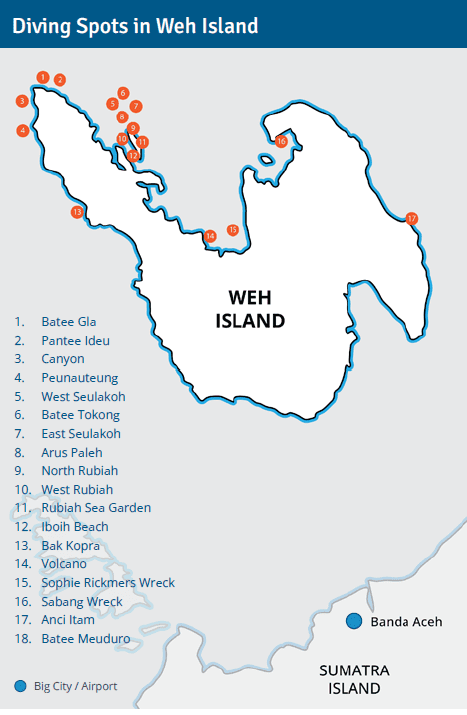 Weh Island has long been a favourite among divers and backpackers, cherished for its remote location and unspoiled charm. Getting there is part of the adventure, with the reward of tranquil beaches, lush jungle, and crystal-clear waters—or simply the chance to unwind in a hammock.
Below the surface, vibrant sea fans, deep canyons, and dramatic rock pinnacles await. Divers and snorkelers can encounter majestic manta rays, whale sharks, and a wealth of marine life. As the northernmost point of Sumatra, Weh Island offers a memorable and fitting finale to any island journey.
How To Get There
- Fly to Banda Aceh Sultan Iskandar Muda International Airport (BTJ)
- Transfer by car (30 minutes) to Ulee Lheue Jetty
- Fast boat (45 minutes) or ferry (1.5 hours) to Weh Island (Balohan Jetty)
Diving Conditions
Weh Island offers some of Indonesia’s finest off-thegrid diving, perfect for those seeking uncrowded sites and rich marine life. The island caters to all experience levels, from beginners to advanced divers. Highlights include drift dives, deep wrecks, and even an underwater volcano. Strong currents bring vibrant marine activity, including both pelagics and macro
species, making for challenging yet rewarding dives.
Visibility : 15 - 35 m
Best Time : Jan - Apr & Sep - Nov (Very rare cooling, slight thermoclines around July–Sept)
Dive Site and Marine Life Highlights in Weh Island
Weh Island boasts remote dive sites rich in marine biodiversity, featuring sharks, manta rays, and whale sharks, as well as schooling pelagics, diverse critters, and vibrant coral reefs nourished by nutrient-rich currents. Its variety of dive environments—including sloping reefs, drop-offs, sandy bottoms, drift dives, and wrecks— caters to divers of all experience levels. Notable sites include The Canyon, with its cave, swim-through arch, and abundant fish life; Pantee Peunateung, known for dramatic topography, colourful sea fans, and macro species; and the Sophie Rickmers wreck, a 1920s cargo ship now thriving with coral and marine life. Arus Balee impresses with its vibrant colors and diverse fish, while Batee Tokong remains a favorite for its rich marine variety. Freedivers will also find excellent opportunities to encounter large species and explore these dynamic underwater landscapes.
WEH ISLAND
Weh Island has long been a favourite among divers and backpackers, cherished for its remote location and unspoiled charm. Getting there is part of the adventure, with the reward of tranquil beaches, lush jungle, and crystal-clear waters—or simply the chance to unwind in a hammock.
Below the surface, vibrant sea fans, deep canyons, and dramatic rock pinnacles await. Divers and snorkelers can encounter majestic manta rays, whale sharks, and a wealth of marine life. As the northernmost point of Sumatra, Weh Island offers a memorable and fitting finale to any island journey.
How To Get There
- Fly to Banda Aceh Sultan Iskandar Muda International Airport (BTJ)
- Transfer by car (30 minutes) to Ulee Lheue Jetty
- Fast boat (45 minutes) or ferry (1.5 hours) to Weh Island (Balohan Jetty)
Diving Conditions
Weh Island offers some of Indonesia’s finest off-thegrid diving, perfect for those seeking uncrowded sites and rich marine life. The island caters to all experience levels, from beginners to advanced divers. Highlights include drift dives, deep wrecks, and even an underwater volcano. Strong currents bring vibrant marine activity, including both pelagics and macro
species, making for challenging yet rewarding dives.
Visibility : 15 - 35 m
Best Time : Jan - Apr & Sep - Nov (Very rare cooling, slight thermoclines around July–Sept)
Dive Site and Marine Life Highlights in Weh Island
Weh Island boasts remote dive sites rich in marine biodiversity, featuring sharks, manta rays, and whale sharks, as well as schooling pelagics, diverse critters, and vibrant coral reefs nourished by nutrient-rich currents. Its variety of dive environments—including sloping reefs, drop-offs, sandy bottoms, drift dives, and wrecks— caters to divers of all experience levels. Notable sites include The Canyon, with its cave, swim-through arch, and abundant fish life; Pantee Peunateung, known for dramatic topography, colourful sea fans, and macro species; and the Sophie Rickmers wreck, a 1920s cargo ship now thriving with coral and marine life. Arus Balee impresses with its vibrant colors and diverse fish, while Batee Tokong remains a favorite for its rich marine variety. Freedivers will also find excellent opportunities to encounter large species and explore these dynamic underwater landscapes.
BELITUNG
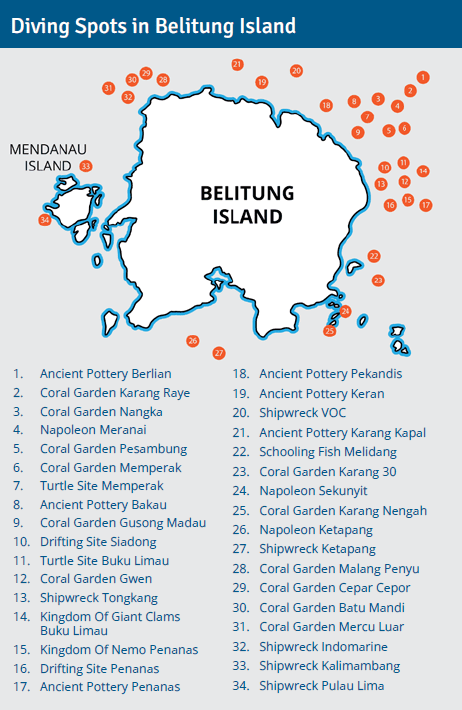 Belitung, part of the Bangka-Belitung province in Sumatra, spans 4,800 km² (1,853 square miles). The island is characterized by its sandy beaches, coral reefs, marshes, and low-lying terrain, with most areas situated below 40 meters above sea level. The Cerutuk River, navigable for 11 km, serves as the main waterway.
Tanjungpandan, the island’s main town, port, and airport hub, connects visitors to the rest of Indonesia. Once known for tin mining, Belitung has transformed into a tranquil island escape. Its pristine beaches, coconut-lined shores, and the crystal-clear waters of the South China Sea offer a serene tropical experience.
Dutch colonial influences are still evident, and the island's friendly and inquisitive locals further enhance the island’s peaceful atmosphere. Minimal commercial fishing allows for sustainable, fresh seafood to feature prominently in local cuisine. Beyond diving, visitors can explore wildlife-rich forests, hike in search of tarsier monkeys, or relax at Tanjung Kelayang—Belitung’s most iconic beach, renowned for its breathtaking views and laidback atmosphere.
How To Get There
- Fly to Tanjung Pandan H.A.S. HanandjoeddinInternational Airport (TJQ)
- Daily speedboats from Pangkalpinang on Bangka Island to Belitung (4 hours)
- PELNI ships from Jakarta (Tanjung Priok Port) (24 hours)
Diving Conditions
Belitung offers ideal diving conditions for all experience levels—from calm, sheltered sites perfect for beginners to deeper areas and exciting drift dives for advanced divers. Exceptional visibility reveals the island’s vibrant underwater landscapes in full clarity.
Visibility : 10 - 25 m
Best Time : Apr - Oct (Occasional upwellings June–Sept can drop to 26 °C, especially in exposed sites)
Dive Site and Marine Life Highlights in Belitung Island
Belitung offers a distinctive diving experience, shaped by underwater pinnacles and volcanic granite formations that create diverse habitats teeming with marine life. Healthy coral ecosystems support an abundance of reef fish, crustaceans, and vibrant macro species, making the region especially appealing to underwater photographers. In Belitung, Cepor Cepor features a colorful coral garden framed by granite boulders, attracting a variety of reef fish, sea urchins, and anemonefish. The Lighthouse Wreck, now richly encrusted with coral, is home to moray eels, nudibranchs, and occasional reef sharks, offering excellent opportunities for exploration. Freedivers will appreciate the region’s dramatic drop-offs and steep slopes, though caution is advised due to currents, and boat support is recommended for safety.
BELITUNG
Belitung, part of the Bangka-Belitung province in Sumatra, spans 4,800 km² (1,853 square miles). The island is characterized by its sandy beaches, coral reefs, marshes, and low-lying terrain, with most areas situated below 40 meters above sea level. The Cerutuk River, navigable for 11 km, serves as the main waterway.
Tanjungpandan, the island’s main town, port, and airport hub, connects visitors to the rest of Indonesia. Once known for tin mining, Belitung has transformed into a tranquil island escape. Its pristine beaches, coconut-lined shores, and the crystal-clear waters of the South China Sea offer a serene tropical experience.
Dutch colonial influences are still evident, and the island's friendly and inquisitive locals further enhance the island’s peaceful atmosphere. Minimal commercial fishing allows for sustainable, fresh seafood to feature prominently in local cuisine. Beyond diving, visitors can explore wildlife-rich forests, hike in search of tarsier monkeys, or relax at Tanjung Kelayang—Belitung’s most iconic beach, renowned for its breathtaking views and laidback atmosphere.
How To Get There
- Fly to Tanjung Pandan H.A.S. HanandjoeddinInternational Airport (TJQ)
- Daily speedboats from Pangkalpinang on Bangka Island to Belitung (4 hours)
- PELNI ships from Jakarta (Tanjung Priok Port) (24 hours)
Diving Conditions
Belitung offers ideal diving conditions for all experience levels—from calm, sheltered sites perfect for beginners to deeper areas and exciting drift dives for advanced divers. Exceptional visibility reveals the island’s vibrant underwater landscapes in full clarity.
Visibility : 10 - 25 m
Best Time : Apr - Oct (Occasional upwellings June–Sept can drop to 26 °C, especially in exposed sites)
Dive Site and Marine Life Highlights in Belitung Island
Belitung offers a distinctive diving experience, shaped by underwater pinnacles and volcanic granite formations that create diverse habitats teeming with marine life. Healthy coral ecosystems support an abundance of reef fish, crustaceans, and vibrant macro species, making the region especially appealing to underwater photographers. In Belitung, Cepor Cepor features a colorful coral garden framed by granite boulders, attracting a variety of reef fish, sea urchins, and anemonefish. The Lighthouse Wreck, now richly encrusted with coral, is home to moray eels, nudibranchs, and occasional reef sharks, offering excellent opportunities for exploration. Freedivers will appreciate the region’s dramatic drop-offs and steep slopes, though caution is advised due to currents, and boat support is recommended for safety.
RIAU ISLANDS
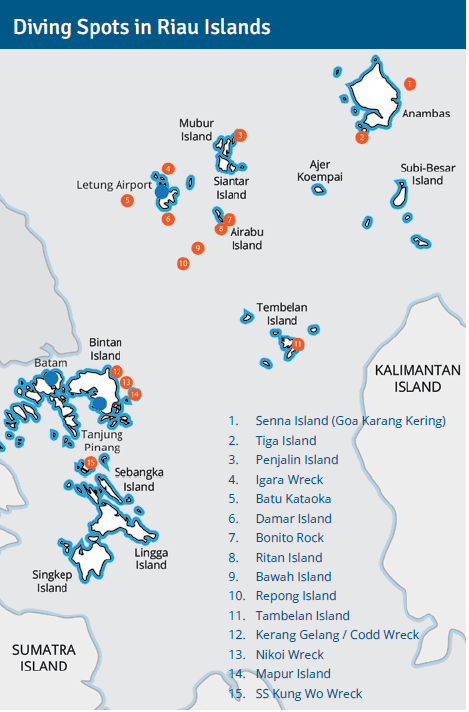 The Riau Islands—comprising Bintan, Batam, Karimun, the Lingga Archipelago, and the Anambas Islands—offer exceptional diving in clear, warm waters with visibility reaching up to 30 meters (100 feet). Vibrant coral reefs filled with sea turtles, rays, and colorful reef fish provide captivating sites for divers of all experience levels.
Popular spots like Penyengat Island (Bintan) and Abang Island (Batam) feature a diverse mix of hard and soft corals, sponges, and macro life, including nudibranchs and octopuses. For more advanced divers, the underwater pinnacles and dramatic drop-offs around Pulau Bawah and Sintang Island attract predatory fish and seasonal pelagics, including manta rays and whale sharks.
Wreck diving is also a highlight, with sunken ships transformed into thriving marine habitats. Whether exploring shallow coral gardens or drifting along deep reef walls, the Riau Islands promise a rich and varied underwater experience.
How To Get There
Fly to Batam Hang Nadim International Airport (BTH) or Tanjung Pinang Raja Haji Fisabilillah Airport (TNJ). Continue by a regional flight to Tarempa Letung Airport (LMU) on Jemaja Island
Ferry from Sri Bintan Pura Harbor in Tanjung Pinang (8 - 9 hours) or from Telaga Punggur Harbour in Batam (8 - 9 hours)
Diving Conditions
The Riau Islands offer clear views of the region’s vibrant and diverse marine ecosystems. They are ideal diving conditions for divers of all skill levels, from calm, protected sites perfect for beginners to deeper, drift dives suited for experienced divers.
Visibility : 10 - 20 m
Best Time : Mar - Oct (Slight surface cooling during northeast monsoon Dec–Feb).
Dive Site and Marine Life Highlights in Riau Islands
The Riau Islands are a diving paradise, known for clear waters, rich coral reefs, and abundant marine life. Dive sites range from pinnacles and drop-offs to dramatic rock formations—perfect for exploration and photography.
Expect encounters with reef fish, turtles, manta rays, reef sharks, and even the occasional whale shark. Bawah Island impresses with vibrant reefs and schools of trevally and barracuda, while Bintan features historic wrecks teeming with life. Macro lovers will spot nudibranchs, cuttlefish, and octopuses, ideal for close-up shots. Freedivers can enjoy striking seascapes, though boat support is advised in deeper or current-prone areas.
RIAU ISLANDS
The Riau Islands—comprising Bintan, Batam, Karimun, the Lingga Archipelago, and the Anambas Islands—offer exceptional diving in clear, warm waters with visibility reaching up to 30 meters (100 feet). Vibrant coral reefs filled with sea turtles, rays, and colorful reef fish provide captivating sites for divers of all experience levels.
Popular spots like Penyengat Island (Bintan) and Abang Island (Batam) feature a diverse mix of hard and soft corals, sponges, and macro life, including nudibranchs and octopuses. For more advanced divers, the underwater pinnacles and dramatic drop-offs around Pulau Bawah and Sintang Island attract predatory fish and seasonal pelagics, including manta rays and whale sharks.
Wreck diving is also a highlight, with sunken ships transformed into thriving marine habitats. Whether exploring shallow coral gardens or drifting along deep reef walls, the Riau Islands promise a rich and varied underwater experience.
How To Get There
Fly to Batam Hang Nadim International Airport (BTH) or Tanjung Pinang Raja Haji Fisabilillah Airport (TNJ). Continue by a regional flight to Tarempa Letung Airport (LMU) on Jemaja Island
Ferry from Sri Bintan Pura Harbor in Tanjung Pinang (8 - 9 hours) or from Telaga Punggur Harbour in Batam (8 - 9 hours)
Diving Conditions
The Riau Islands offer clear views of the region’s vibrant and diverse marine ecosystems. They are ideal diving conditions for divers of all skill levels, from calm, protected sites perfect for beginners to deeper, drift dives suited for experienced divers.
Visibility : 10 - 20 m
Best Time : Mar - Oct (Slight surface cooling during northeast monsoon Dec–Feb).
Dive Site and Marine Life Highlights in Riau Islands
The Riau Islands are a diving paradise, known for clear waters, rich coral reefs, and abundant marine life. Dive sites range from pinnacles and drop-offs to dramatic rock formations—perfect for exploration and photography.
Expect encounters with reef fish, turtles, manta rays, reef sharks, and even the occasional whale shark. Bawah Island impresses with vibrant reefs and schools of trevally and barracuda, while Bintan features historic wrecks teeming with life. Macro lovers will spot nudibranchs, cuttlefish, and octopuses, ideal for close-up shots. Freedivers can enjoy striking seascapes, though boat support is advised in deeper or current-prone areas.